

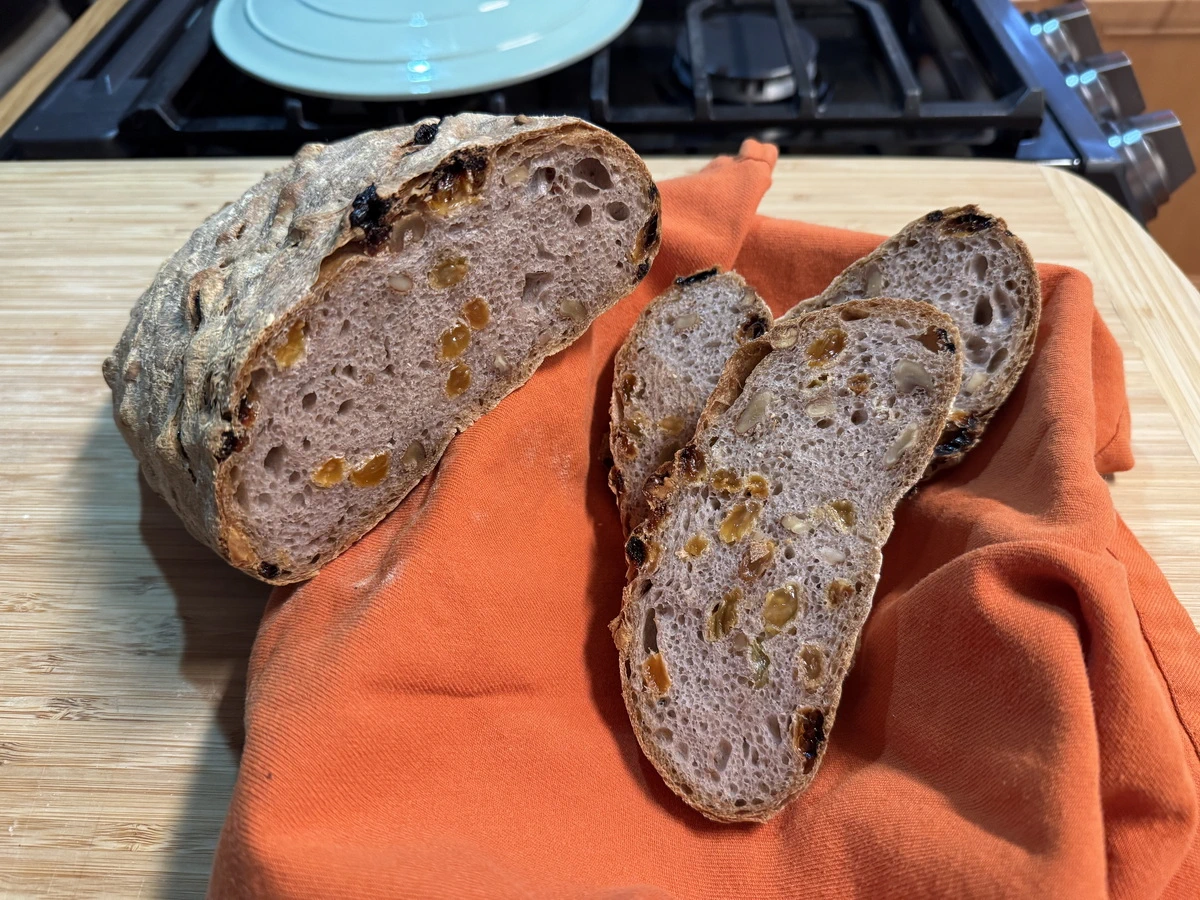
I do think the most difficult part of baking bread is writing an accurate recipe. Actually, the most difficult part of cooking – period – is writing an accurate recipe. There are too many variables – from weather to moisture content of ingredients – to state absolutely that you need 400 g flour and 100 g water to make X. Sometimes it’s 390 g or 120 g. You feel it, you sense it. You start with 400 g and 100 g, but you play and tweak along the way.
That is not easy to convey.
I’ve now been doing this for almost 65 years. While I spent many years being a precision recipe writer when I worked in Nutrition and Dietetics, I’m a tactile cook and baker at heart.
I may use a scale to start, but my hands feel, my eyes see, I hear the mixer or the sizzle of the pan, I smell the herbs and spices – or the burning garlic.
And there’s something deeply satisfying about tactile baking that never really translates into explicitly written recipes — the sense that you’re working with a living material rather than merely executing instructions. Everything you’re making is unique. It’s not about trying to make something taste like something someone else made – it’s making something yourself.
Or making a regional or “authentic” dish. Any idea how many recipes are out there for “Boston Baked Beans”?!? More than a few. Some with no onion, some with a whole onion plopped in the center and then discarded. With salt pork or fat back, or bacon. Some with no meats at all. Navy beans, soldier beans, great northern beans – even pinto or cannellini! And then you get into molasses or honey, apple cider vinegar and dry mustard vs dijon or other mustards. And once you get the ingredients, it’s how much of each you use.
And don’t even start on Meatballs…
The printed recipe is a guideline. It’s a roadmap to get you from point A to point B. But as with any roadmap, it allows you to stop and take detours. Sometimes taking a freeway and sometimes taking back roads. You get there, eventually, but every trip is unique.
That’s a long way of saying I made a loaf of bread, yesterday – from a recipe I have used quite often over the years.
I had made the starter the day before – the recipe states to make the starter 2-3 days in advance. I did slightly less than one.
The recipe also calls for “all-purpose” flour. I really don’t recall when or where I originally got this recipe, but I know at some point I added the rye. Anyway… I made it with bread flour, rye, and white whole wheat.
It seemed a bit on the dry side while mixing – different flours absorb liquids differently.
Since I’m a machine mixer, nowadays – I added a splash of water. Then it looked a bit too loose, so I sprinkled in more flour.
The resulting dough felt just about right – just a tad tacky but easy to handle with floured hands.
The baked loaf ended up being perfect! A really great crunchy chewy crust with a really flavorful crumb – neither moist nor dry. It hit the sweet spot!
We both had it toasted for breakfast this morning with butter and homemade Orange Curd. Heaven on a 7″ plate!
Walnut Raisin Bread
starter
- 6 g (2 tsp) active dry yeast
- 180 g (3/4 cup) water (110°F / 43°C)
- 210 g (1 3/4 cups) flour
Sprinkle yeast into the warm water. Stir to dissolve. Stir in flour. Cover bowl with clean towel and leave at room temperature for 2-3 days.
dough
- 3 g (1 tsp) active dry yeast
- 180 g (3/4 cup) water (110°F / 43°C)
- 240 g (1 cup) starter
- 240 g (2 cups) all-purpose flour
- 40 g (1/3 cup) rye flour
- 30 g (1/4 cup) whole wheat flour
- 9 g (1 1/2 tsp) salt
- 145 g (1 cup) raisins
- 60 g (1/2 cup) chopped walnuts
Sprinkle yeast into water in mixing bowl. Stir to dissolve. Add starter, flours, and salt.
Mix on low speed with dough hook for about 5 minutes or until dough is smooth and elastic. Add raisins and walnuts and continue mixing another 5 or so minutes. Knead by hand for a minute or two on a lightly-floured surface to make sure the nuts and raisins are evenly distributed.. Place the dough into a clean bowl and cover with a kitchen towel.
Let rise until doubled – up to 2 hours. Punch dough down and let rest for about 10 minutes before forming the loaf.
Shape the dough into a cylindrical loaf and place on a bread peel generously coated with coarse cornmeal. Cover with a kitchen towel and let rise again until doubled – about an hour.
Preheat oven with baking stone to 425°.
Dust loaf with flour and then make three parallel slashes across the top. Slide dough onto stone and bake for about 1 hour.
I guess the moral of the story is to allow for detours. I know more than a couple of folks who need a recipe in front of them and need to accurately measure every single thing, chop things exactly as stated, and fret when they add something out of sequence or they think it doesn’t taste just like how someone else had made it. I get it. I understand insecurity in the kitchen. We’re bombarded with advertisements and articles about how we’re too busy to cook, how much trouble it is, and how relaxing and convenient it is to just let everyone microwave what they want to eat. Food conglomerates not only play upon those insecurities, they create them. They want you to buy their pre-made, shelf-stable, nutritionally-unsound food products or go to national chains where every single item looks and tastes exactly the same regardless of whether you’re in Cleveland or San Antonio – or anywhere else.
The following excerpt is from the James Beard Cookbook first published in 1959:
“… you’ll never achieve confidence in your cooking ability if your culinary skill depends on using ingredients that someone else has mixed or seasoned or pre-cooked. Like almost everything else – walking, driving a car, painting a picture – you learn by doing.”
I’ve had my share of cooking disasters. I’ve had cakes fall, vegetables turn to mush, breads not rise, and I’ve over-cooked or under-cooked a myriad of things over the years… I threw away a pot because I couldn’t get the burnt crud out. Every mistake has been a learning experience.
Grab your recipes and go for it. Don’t be bummed if your pie crust isn’t as flaky as mom’s or grandma’s used to be. They were making them for years before you ever tasted one. Keep making them – the important thing is to keep trying.
I think the worst thing that can happen is you throw it out and call for pizza. And while I’ve made a few things in my life I’ll never bother with again, I’ve never had to call for pizza.
Yet.
